- Mateeka House, 57B Katalima Road Naguru
- +256 200 923 345
- admin@useaug.org

Experts Urge Uganda’s Solar Sector to Move Beyond Lighting to Power Productivity

Solar Sector Innovators Honoured at 2026 USEA Awards
October 5, 2026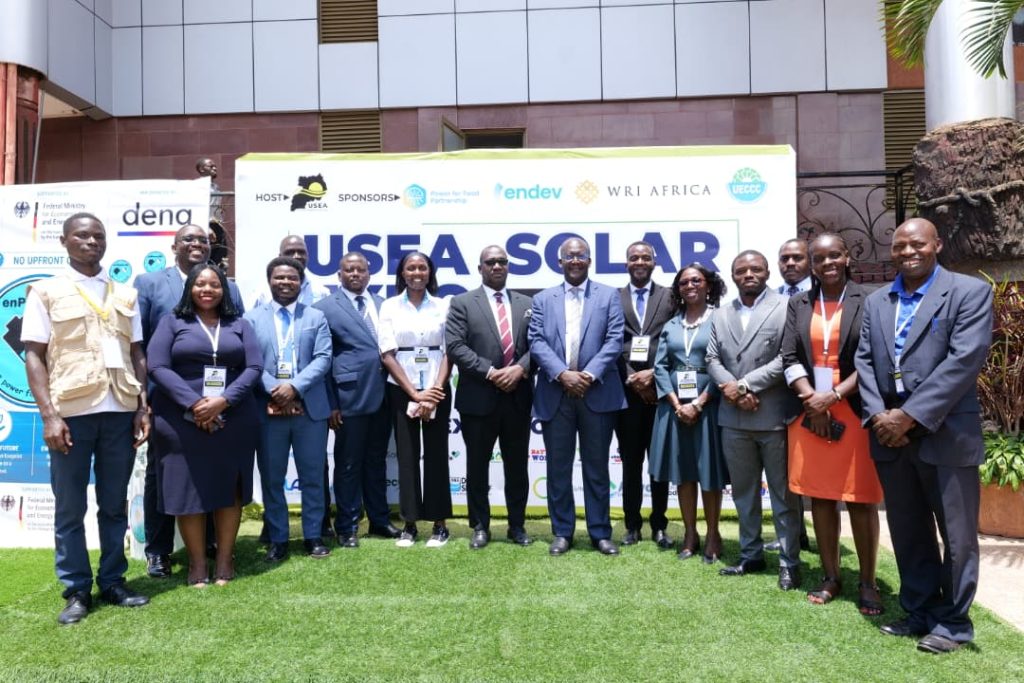
Experts have called for Uganda’s solar energy industry to move beyond the traditional use of solar systems for lighting and phone charging.
These have advised for greater investment in technologies that can power agriculture, businesses, health facilities and other productive activities.
The call was made during the opening of the three-day 2026 Uganda Solar Energy Association (USEA) National Expo and Conference at Silver Spring Hotel in Kampala, held under the theme “Powering Productivity with Solar.”
USEA Board Chairperson Douglas Baguma said there is a need for a major shift in how Uganda should measure progress in the solar sector.
“For many years, we’ve measured progress through a number of solar panels sold, systems installed, households connected, or megawatts generated. However, energy access is not the final destination. The more important question is, what does that energy enable people to do,” Baguma said.
He said solar should increasingly be used to power productive activities such as irrigation, milk cooling, fish preservation, produce drying, grain milling, workshops and health facilities.
“A solar system that provides lighting transforms a household. But when solar energy pumps water for irrigation, cools milk, preserves fish, dries produce, mills grain, powers a workshop or supports a health facility, it begins to transform an economy,” he said.
According to Baguma, the sector’s next phase should focus on improving livelihoods, expanding businesses and creating productive employment rather than concentrating solely on household connections.
“The true measure of our progress must not only be how much solar equipment we deploy, but how many livelihoods improve, how many businesses grow, and how many productive jobs are created,” he said.
He noted that Uganda had already demonstrated that off-grid solar can reach large numbers of households, but productive-use technologies were developing more slowly.
“Recent experience also shows that productive use technologies are scaling more slowly than household energy systems. This is not a reason for pessimism. It is a clear assignment for all of us,” Baguma said.
According to him, the industry now needs to connect solar technology with finance, markets, skills, quality services and supportive policies.
UNICEF Uganda Chief of WASH, Climate and Environment Lalit Patra said the flexibility of solar makes it particularly important for communities that remain beyond the reach of the national grid.
“The scope for solar energy is enormous. Solar energy is such a flexible energy, it can reach anywhere in the country, in the remotest of the villages, in the remotest of the household,” Patra said.
He said solar was already supporting electrification of schools and health facilities, particularly in locations where grid electricity is unavailable.
However, Patra said expanding solar access must also take into account the ability of households and businesses to pay for the technology.
“Your industry needs to produce things which will meet the purchasing power of the people,” he said.
He challenged government to provide a policy and regulatory environment that enables the industry to grow, including consideration of incentives for local solar manufacturing.
“You have to make sure there is something called regulatory system, which is not like creating obstruction for the industry, but an enabler for the industry,” Patra said.
Uganda Energy Credit Capitalisation Company(UECCC) Managing Director Roy Baguma said Uganda must similarly move away from viewing solar merely as a source of electricity for basic needs and instead use it as an engine for economic transformation.
“For many years, discussions around energy access in the off-grid areas focused on lighting and phone charging. Uganda is increasingly recognising that energy must go beyond basic access for lighting and should become the much-needed catalyst for economic transformation, enterprise growth, job creation and wealth creation.”
Roy Baguma said productive-use solar could support agriculture, trade, manufacturing and services through technologies such as irrigation systems, water pumps, refrigeration, cold storage, grain mills and agro-processing equipment.
“Solar energy is therefore no longer merely a source of light. Today it is a productive asset that supports businesses, modernises agriculture, promotes value addition and improves livelihoods altogether,” he said.
The USEA board chairperson, Douglas Baguma called for technicians capable of installing and maintaining productive-use systems in every district,
He noted that Uganda should eventually move into designing, manufacturing and exporting solar technologies rather than remaining primarily a consumer of imported equipment.
“Uganda must progressively participate in designing, manufacturing, and exporting the technologies that will empower Africa’s development,” he said.